
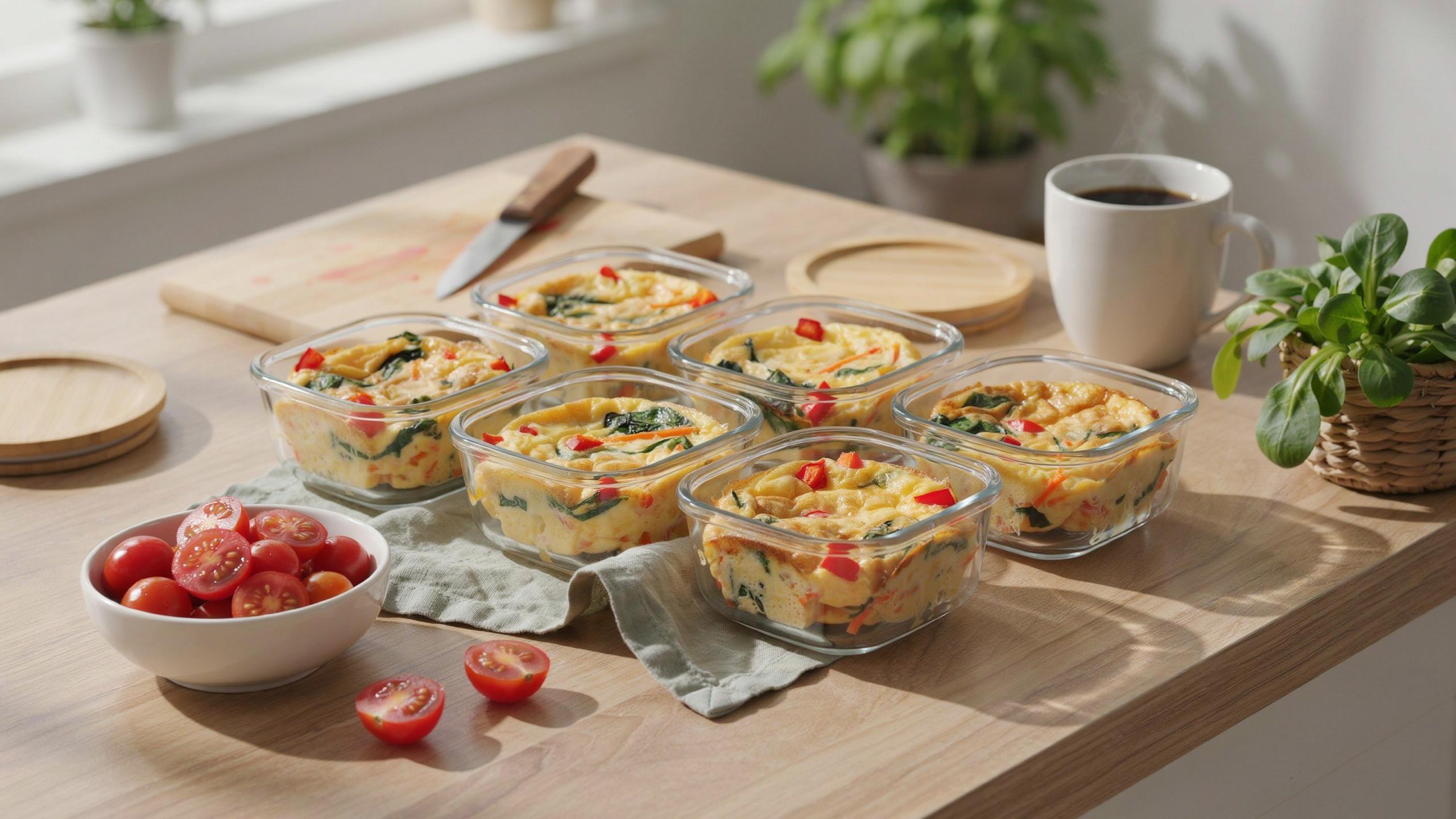
The Myth Of Effortless Healthy Eating Why Most Egg Muffins Fail

Where Meal Prep Actually Fails
You want to believe that Sunday cooking solves the willpower problem all week. It doesn’t. The mechanism at work here is what economists call the planning fallacy: you overestimate your future compliance with a system you designed while motivated. Egg muffins fail because people build them around what sounds good in theory, not what they’ll actually eat when tired or stressed. Most prep recipes ignore texture degradation. A veggie egg muffin tastes acceptable on Monday. By Wednesday, the vegetables release moisture, the eggs firm up wrong, and the whole thing tastes like wet cardboard. You skip it. Prep fails not from lack of effort but from ignoring storage science.

The real cost isn’t the hour on Sunday. It’s the food waste, the grocery money spent on ingredients you don’t finish, and the psychological hit when your “perfect system” collapses by midweek. People fixate on the recipe and ignore the storage container, cooking method, and vegetable selection. A muffin made with high-water vegetables like zucchini or tomatoes degrades faster than one built around lower-moisture options like spinach or bell peppers. You can’t outplan bad design. The solution is reversing your priorities: storage stability first, then recipe.
The Convenience Trap Without A Real System
Convenience without strategy is just buying expensive mistakes. You prep egg muffins thinking you’ve solved breakfast, but you’ve only created a friction point if the system doesn’t account for how your week actually moves. Economics teaches us about hidden costs, and veggie egg muffin prep has one most people ignore: the mental load of deciding whether something is still good to eat. A muffin that lasts five days is convenient. One that lasts four is a gamble by day five, and you end up tossing it.

The hidden cost lives in your decision fatigue, not your time. You spent Sunday cooking. Now every morning you evaluate whether the muffin is worth eating. That evaluation drains you more than the initial prep. Real strategy means building muffins that taste as good on day five as day one, which requires specific ratios of eggs to vegetables, proper cooling before storage, and containers that prevent moisture buildup. The protocol is simple: cool completely before sealing, store in airtight containers, and use vegetables that hold texture under refrigeration for seven days minimum.
Beyond The Recipe Deconstructing The Perfect Healthy Breakfast

What Your Body Actually Needs To Not Crash
You want to feel like you have willpower all morning. Here’s the real mechanism: breakfast determines your blood glucose trajectory for the next four hours. Protein stabilizes this curve. Fat slows digestion. Carbs spike it fast. Most people skip the first two and wonder why they’re ravenous by 10 AM. Veggie egg muffins work because they pack all three in one portable unit, but only if you understand the ratios that prevent the energy collapse.
A standard egg muffin contains roughly 12 to 15 grams of protein per serving, depending on how many eggs you use. Add one ounce of cheese and you hit 18 grams. Two tablespoons of whole milk or cream bring the fat to 8 to 12 grams. This combination keeps blood glucose stable for 240 minutes or longer. Vegetables add fiber, which further delays glucose absorption. The math is simple: protein plus fat plus fiber equals no energy crash at noon.
The Reason Most Egg Muffins Fail You
The conventional wisdom says “just add veggies and you’re done.” It’s wrong. Most people make egg muffins that taste like compressed gym protein with specks of bell pepper. The vegetables are there for optics, not function. They contribute almost nothing to satiety or nutrient density. You need vegetables that actually work, not vegetables that look virtuous.
The mechanism borrowed from nutrition science is bioavailability, the rate at which your body absorbs nutrients. Raw spinach contains oxalates that block mineral absorption. Cooked spinach breaks down cell walls and increases iron uptake by 300 percent. Broccoli raw contains myrosinase that creates sulforaphane, an anti-inflammatory compound destroyed by overcooking. The vegetables you choose and how you prepare them determine what your body actually absorbs. Roast or sauté vegetables first, cool them completely, then fold them into your egg mixture. This step separates functional meal prep from theater.
The Foundational Five Essential Veggie Egg Muffin Ingredients

Vegetables That Actually Move The Needle
You want to believe that any vegetable works equally, but that’s denial masking a real fear: wasting time on prep that doesn’t deliver results. The mechanism is nutrient density per prep effort. In nutrition science, this means maximizing micronutrients and fiber while minimizing prep complexity. You’re not making salad. You’re engineering a compact delivery system that survives five days in a container.
- Bell peppers: High in vitamin C and carotenoids. Raw or roasted, they hold texture through reheating and don’t leach water into the muffin base. Dice them small for even distribution.
- Spinach: Wilts into the egg matrix without creating moisture problems. Delivers folate and iron with minimal prep. One handful per muffin prevents density issues that sabotage texture.
- Mushrooms: Provide umami and absorb excess moisture from other vegetables. Finely chopped, they integrate seamlessly without introducing new flavors that clash with eggs.
- Broccoli: Offers sulforaphane compounds and structural integrity when chopped into small florets. Must be blanched briefly before muffin assembly to eliminate excess moisture.
- Zucchini: Low water content relative to volume when salted and drained first. Adds bulk without inflating calorie density or creating a soggy final product.
Stop rotating vegetables randomly based on what looks good at the store. The vegetables that survive five days intact and taste consistent on day one and day five are the only ones worth your muffin tin space. Pick three from this list, master them, then experiment.
Protein And Fat Beyond The Obvious
Everyone defaults to eggs as the entire protein solution, which leaves nutrient gaps and taste monotony. Eggs provide structure, but they’re a delivery mechanism, not the destination. You need fat solubility for vitamin absorption and protein variety for amino acid profile optimization.
Cooked bacon or sausage adds 6 to 8 grams of protein per muffin while contributing the fat needed for egg coagulation and flavor complexity. Feta or goat cheese introduces a salty, acidic note that keeps muffins from tasting one-dimensional across five days. Cottage cheese increases protein density without hardening the muffin texture the way dense cheeses do. Ground turkey or chicken, precooked and seasoned, works when you’re chasing pure protein without additional fat. The ratio is typically 1 part protein addition to 2 parts egg base, which maintains moisture balance and prevents a rubbery final product. Add your protein choice directly to the raw egg mixture before pouring into muffin cups.
The Autonomous Breakfast Protocol For Veggie Egg Muffins

Measuring What Matters To Stay Consistent
You want to believe willpower is enough. It isn’t. The mechanism here is cybernetics—the study of feedback loops in self-regulating systems—and you need one that actually triggers correction before you skip breakfast. Most people track calories or macros. That’s measuring the output, not the behavior. What you measure is what you repeat, so measure the input: prep completion rate, muffin consumption per day, and days elapsed since last batch. When you check these three data points Sunday night, your brain registers success or failure in concrete terms. This creates a feedback loop where deviation becomes visible before it becomes habitual. You’re not relying on motivation. You’re building a system that talks back to you.
Your feedback mechanism lives in one place. Write three numbers every Sunday: muffins prepped, muffins eaten last week, days until next prep day. Pin this to your fridge or phone notes. The act of writing forces acknowledgment. If you prepped 24 muffins but only ate 16, the gap tells you why before you guess. Maybe portion size is wrong. Maybe the flavor combination isn’t working. Maybe your schedule changed. The numbers answer the question your gut can’t articulate. This transforms veggie egg muffin meal prep from a motivation problem into a data problem, which you can actually solve.
Blocking Drift Before It Starts
Generic advice says stay disciplined. That’s useless. The real move is pre-commitment design, the cybernetic concept of removing future choice through present action. You don’t decide whether to eat breakfast on Tuesday morning at 7am. That decision was made Sunday at 3pm when you pulled the muffins out of the oven. Deviation requires extra steps: thawing, reheating, resisting alternatives. Adherence requires nothing. You remove the future decision by making it impossible to execute the competing behavior. Put muffins in a labeled container at eye level. Remove other breakfast options from immediate access. The environment does the work your willpower can’t sustain.
Your prep day logistics matter more than your intentions. Set a specific time block Sunday afternoon, not morning. Afternoon gives you energy cushion before the week. Use the same equipment, same counter space, same recipe every week. Repetition embeds the process so deeply that starting prep feels automatic, not optional. When you’ve made the same batch eight times, deviation requires conscious effort rather than default behavior. This is why restaurant kitchens prep at the same time using identical stations. The system succeeds because the human becomes a variable you’ve already controlled.
Batch Cooking Brutality Maximize Your Weekly Output
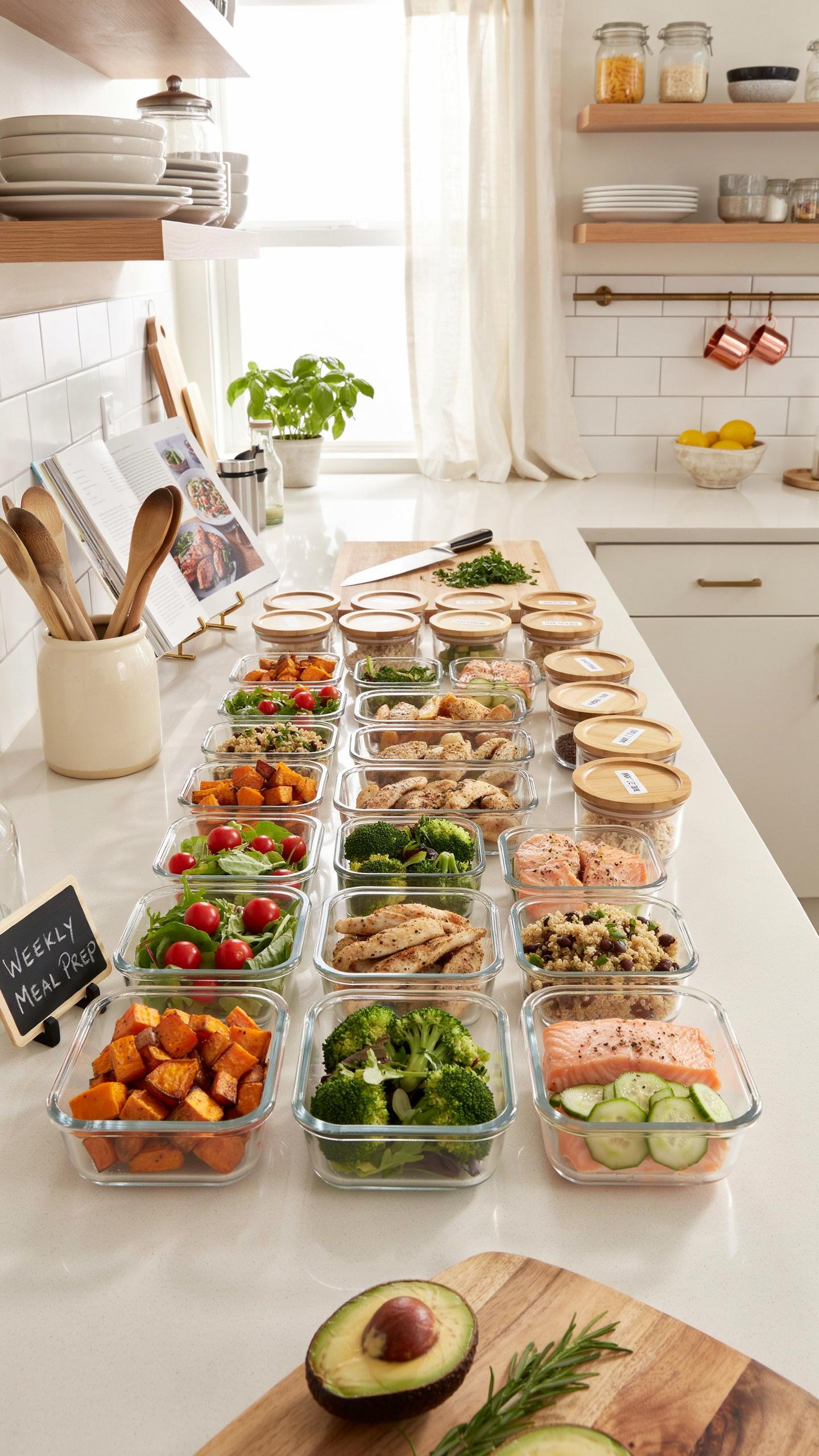
The Right Equipment Cuts Prep Time In Half
You want to believe effort alone matters. It doesn’t. Industrial kitchens solved this problem decades ago through equipment selection, not willpower. The constraint that kills most meal preppers isn’t motivation—it’s friction in the assembly process. A muffin tin with poor release properties costs you five minutes per batch. A mixing bowl too small forces you to work in segments. A dull knife turns vegetable chopping into punishment.
Start with a commercial-grade muffin tin, preferably silicone or heavy-gauge steel with nonstick coating. A large stainless steel mixing bowl lets you prep a full week’s batch without refilling. A sharp 8-inch chef’s knife handles peppers and onions in one-third the time of a dull blade. A food processor turns two minutes of manual chopping into 30 seconds. Buy a kitchen scale to weigh portions—it eliminates the guesswork that slows you down. These tools aren’t luxuries. They’re force multipliers that compress your labor.
The Assembly Line Model That Cuts Chaos
Most people make veggie egg muffins one batch at a time, mixing and baking sequentially. That’s backwards. Use a manufacturing assembly line approach: prep all vegetables first, cook all proteins, combine everything, then bake all muffins at once. This staggers your effort and eliminates repetitive setup and cleanup.
Dice all peppers, onions, and mushrooms into separate bowls before you crack a single egg. Cook any proteins like sausage or bacon in bulk on your stovetop while vegetables sit prepped. Whisk all eggs in your largest bowl with salt and pepper at one time. Distribute vegetables into muffin cups, add protein, then pour egg mixture across all tins simultaneously. Bake at 350°F for 22 to 24 minutes. This method batches repetitive tasks and cuts total time by 40 percent compared to making individual batches.
Flavor Engineering Avoiding Veggie Egg Muffin Boredom

Dynamic Spice Profiles And Herb Combinations
You’re scared these muffins will taste identical by Wednesday. The real problem isn’t repetition—it’s that you’re treating flavor like a fixed property instead of a variable you control. Borrow from sensory science: flavor perception requires contrast. Your palate adapts to static inputs and stops registering them. Change the spice profile, not the base ingredients, and you reset that adaptation cycle every two days.
A muffin with cumin, smoked paprika, and black pepper reads completely different from one with Italian seasoning, red pepper flakes, and garlic powder—even if both contain the same eggs, spinach, and cheese. The vegetables stay constant. The protein stays constant. The texture stays constant. Only the volatile compounds in your spices shift. Your brain registers “new meal” because it actually detects new signals. Layer three or four distinct spice combinations across your week and rotate them deliberately.
Strategic Ingredient Rotation, Not Reinvention
The generic advice says “mix it up”—which is useless. You don’t need a different muffin every day. You need a repeating system with one controlled variable. Build two base recipes. Recipe A: spinach, mushroom, cheddar. Recipe B: bell pepper, onion, feta. Make half your batch with Recipe A on Sunday. Make the other half with Recipe B. By rotating between these two, you get perceived variety without planning chaos or buying twenty ingredients.
This works because your brain compartmentalizes. You eat Muffin A Monday and Tuesday. Wednesday hits Recipe B, and your taste buds reset. Friday comes back around to Recipe A, but three days have passed, so it feels fresh again. The mechanism is time plus contrast, not complexity. You’re not reinventing the wheel each prep session—you’re cycling through two proven formulas that take identical time to execute.
Storage And Retrieval Keeping Your Egg Muffins Fresh
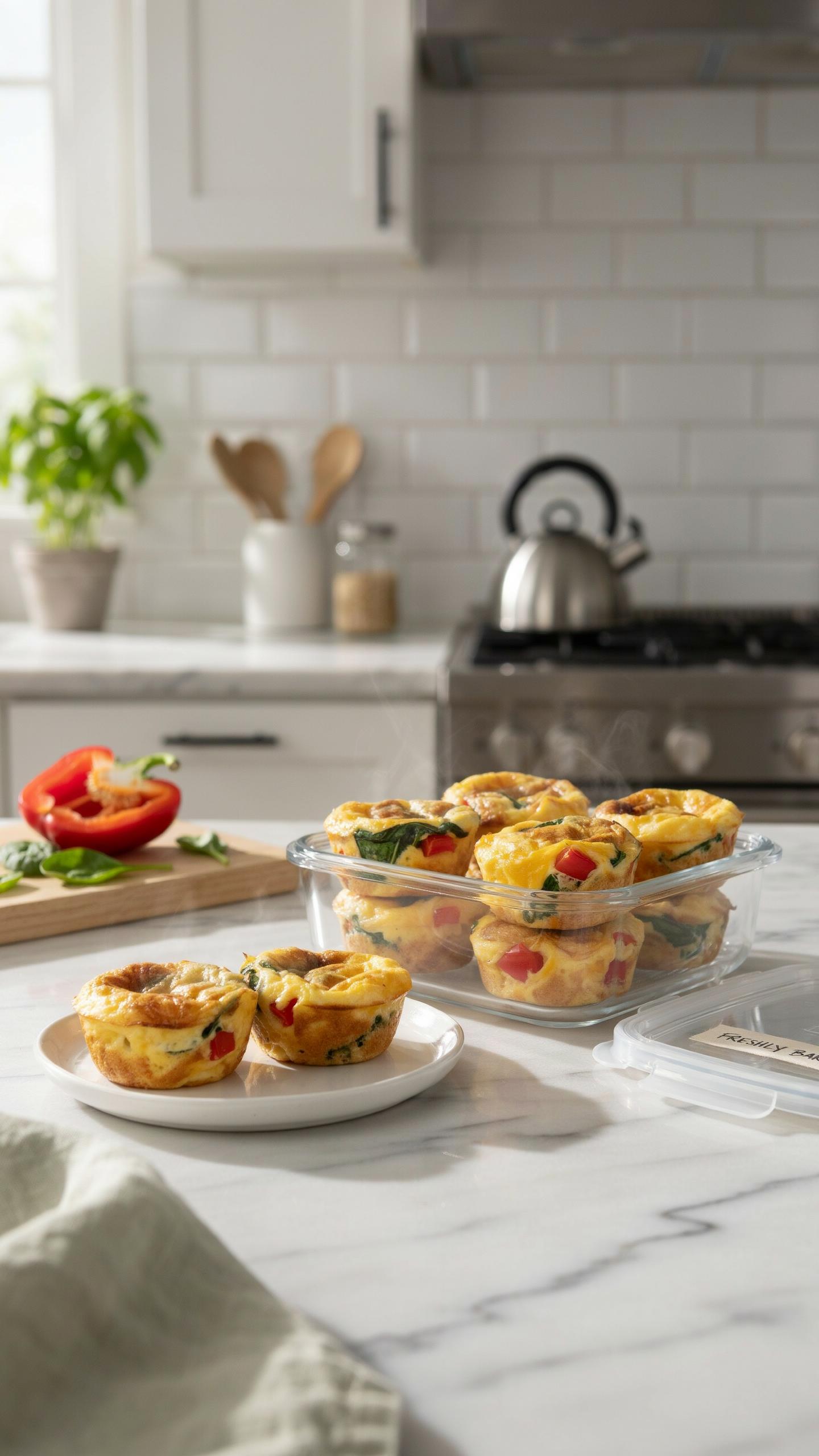
Cool Them Before You Box Them
You care about this because spoiled food feels like wasted money and effort, but that’s not the real cost. The mechanism is simple: warm muffins trapped in an airtight container create condensation, which breeds bacteria and turns your prep work into biohazard. Cool them to room temperature first, then refrigerate. This takes two to three hours on the counter or thirty minutes in the freezer. Rushing this step defeats the entire point of meal prep.
Moisture is the enemy of shelf life. After your muffins finish cooking and you pull them from the tin, let them sit uncovered on a wire rack. Air circulates underneath and around them, releasing steam instead of trapping it. Once they’ve cooled completely, transfer them to an airtight container or individual glass storage boxes. Glass holds up better than plastic over time and doesn’t absorb odors or stains from repeated use.
Reheat Without Turning Rubber
The common advice is to microwave them, which is lazy and wrong. Microwaves apply heat unevenly, leaving hot spots and turning the egg rubbery while the center stays cold. Use your oven instead. Preheat to 350 degrees Fahrenheit and place your muffins on a baking sheet for six to eight minutes. The dry heat restores texture by rehydrating the egg structure gradually instead of shocking it. This is borrowed from thermodynamics: controlled energy input preserves molecular integrity better than rapid bombardment.
You can also reheat directly from frozen without thawing. Add two to three minutes to the oven time and check for doneness. For toaster ovens, the same temperature works but watch closer since heating zones are tighter. Never reheat more than twice. Each cycle degrades texture further, and by the third round you’re eating chalk with vegetables in it.
Beyond Breakfast Low Carb Breakfast Applications

When Breakfast Stops Being Breakfast
You want permission to eat egg muffins outside the morning window because you’re tired of rigid meal timing rules. Here’s the mechanism: egg muffins are a protein-fat delivery system wrapped in a portable package. They have no carb dependency, no glycemic spike, no digestive urgency. That means your body doesn’t care when you eat them. A 2-hour breakfast window is marketing invented by cereal companies. Egg muffins work at 11 AM, 3 PM, or midnight because they don’t trigger the hormonal cascade that demands you eat again in two hours.
The real application is treating them as a metabolic buffer between meals. You eat one when hunger arrives but you’re not ready for a full meal. You eat one when you need calories but don’t want the crash that follows carbs. Most people think snacks have to be small and pointless. Egg muffins flip that: a single muffin delivers 12-15 grams of protein, 8-10 grams of fat, and zero blood sugar disruption. That’s not a snack. That’s a mini meal that actually works.
Stacking With Real Food, Not Alternatives
Pairing advice online defaults to fruit, toast, or Greek yogurt. That’s incomplete because those foods require complementary foods to work. An egg muffin plus toast is carbs waiting for fat to slow digestion. An egg muffin plus fruit is sugar with protein, which still creates a glycemic response. The better protocol: pair egg muffins with foods that already exist in your diet as standalone items.
A spinach-feta egg muffin with a handful of almonds requires no mental load. A mushroom-cheese muffin with sliced avocado is a complete plate. Cold cuts, cheese, olives, nuts, seeds, and raw vegetables all work because they’re already nutrient-dense on their own. You’re not “balancing” anything. You’re stacking density on density. The mechanism is simple: no food in the pairing needs processing or additional components to deliver satiety.
The 7 Day Challenge Mastering Your Egg Muffin Meal Prep
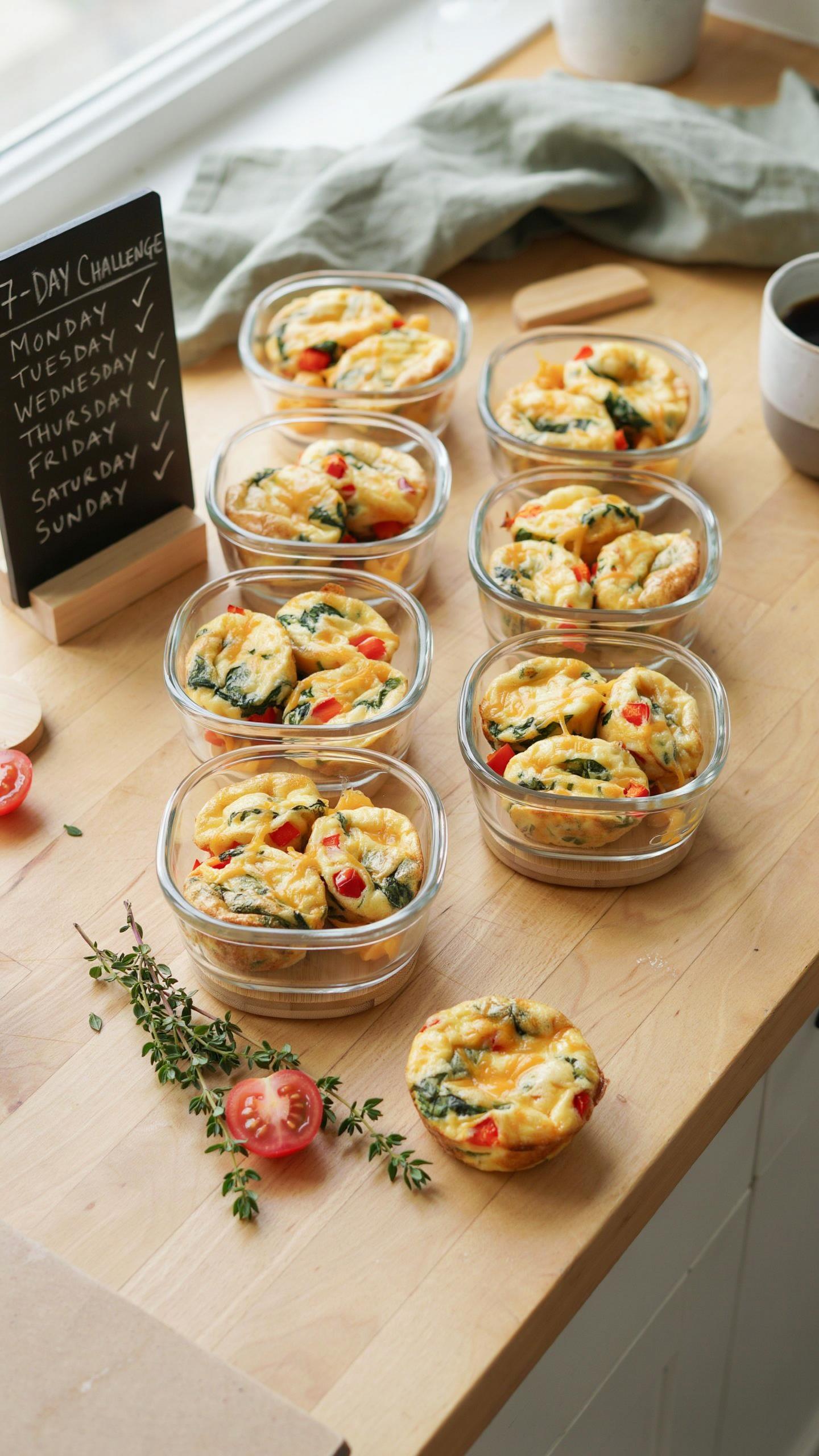
Start Small, Not Perfect
You want this to feel effortless so you can tell people you have your nutrition dialed in. The real mechanism is that perfection kills consistency, and consistency is the only variable that matters. Most people sabotage themselves by attempting a full week of twelve muffins on day one. You don’t need that. Start with three muffins, done right, eaten consistently for three days. You build the neural pathway of the behavior before scaling the volume.
The reason this works is neurological, not motivational. Your brain doesn’t care about the goal. It cares about the ritual. Repeat the same three-muffin batch until the process becomes automatic. Once you can execute without friction, add three more. By week three you’re at twelve without ever hitting a wall. This beats the Sunday afternoon heroics that leave you burned out by Wednesday.
Track What Matters, Not What’s Easy
The scale is a broken feedback mechanism for meal prep. You’re looking for the wrong signal entirely. What actually predicts success is adherence rate, energy stability through midday, and whether you’re reaching for snacks at 3 p.m. These are the real outputs. Weigh yourself if you must, but track these three metrics instead: How many days did you eat the muffins as planned? Did your energy crash between lunch and dinner? Did you buy convenience food on day four?
Record these on a simple notepad or your phone. One number per day. After seven days you have the data. You’ll see patterns that the scale never reveals. If adherence dropped on day five, you know the recipe needs adjustment or your storage method failed. If energy stayed flat, your egg-to-vegetable ratio is working. This becomes your tuning mechanism for the next batch. You’re not chasing a feeling. You’re collecting evidence.
The real obstacle isnt the muffin recipe its your flawed system for showing up consistently

You already know veggie egg muffin meal prep works. The problem is you’ll make them once, feel virtuous, then slip back into takeout within two weeks. The recipe didn’t fail you. Your environment did. Pick one specific day this week, block it on your calendar like it’s non-negotiable, and commit to batch cooking for just one month. Not forever. One month. You’ll either build the habit or prove to yourself you’re not actually ready to change. Either way, you’ll stop lying to yourself about it.